The Kratky method is the simplest way to grow food without soil. You fill a container with nutrient solution, set a plant in a net pot just above it, and walk away. There is no pump, no air stone, no timer and no electricity. As the plant drinks, the water level drops, and the roots that are left in the air take in the oxygen they need.
If you have never grown anything hydroponically, this is where to start. A single jar of lettuce on a windowsill will teach you more about pH, nutrients and roots than a month of reading. And if you already run a pumped system, Kratky is the easiest way to add a few extra plants without adding work.
This guide covers everything: how the method works, what you need, a step-by-step setup, nutrient strength and pH, which plants succeed (and which don't), how much water each plant needs, and how to fix the problems that come up most often.
Quick answer: The Kratky method is a passive, non-circulating hydroponic technique. Plants sit in net pots over a sealed reservoir of nutrient solution. The roots start in the solution; as the plant uses water, an air gap forms and the upper roots breathe from it. Lettuce grown this way is usually ready to harvest 30 to 45 days after transplanting.
What is the Kratky method
The Kratky method is a form of hydroponics that does not move water or air. It was developed by Dr. Bernard A. Kratky, a horticulturist at the University of Hawaii's Department of Tropical Plant and Soil Sciences, who worked on non-circulating systems from the early 1990s and published his best-known results on lettuce in 2009.
Kratky's goal was practical: a way for anyone to grow vegetables without soil, power or technical skill. Most hydroponic systems depend on electricity to pump water or bubble air through it. That has three costs. It adds to your power bill, a power cut can kill a crop within hours, and it rules out places where electricity is unreliable. Kratky removed all three by letting the plant manage its own oxygen.
You will see the method described with several names. They all mean the same thing:
- Kratky hydroponics or the Kratky method
- Passive hydroponics
- Non-circulating hydroponics
- Mason jar hydroponics, when the container is a jar
How it works: the air gap and the two kinds of roots
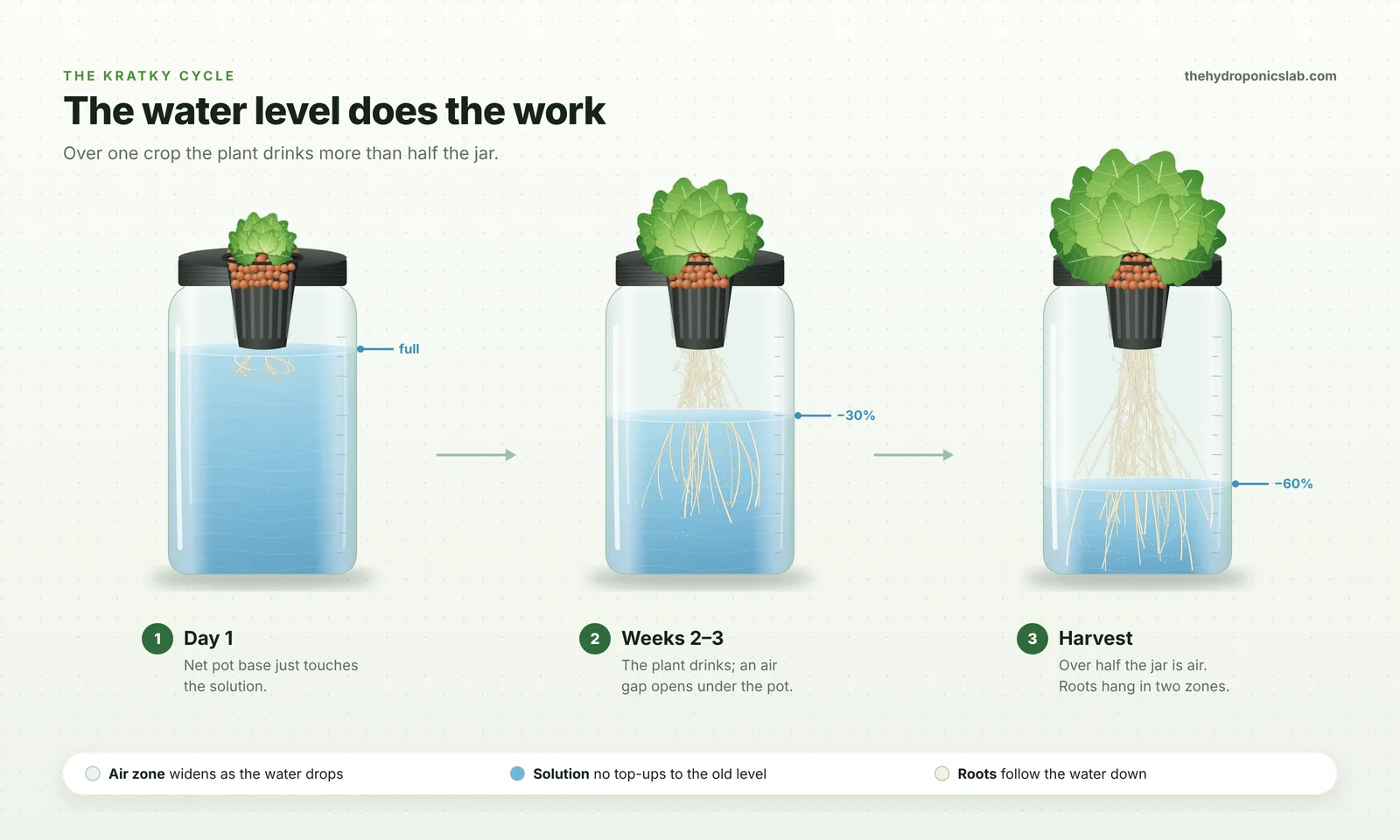
The whole method rests on one idea: the falling water level creates the oxygen supply.
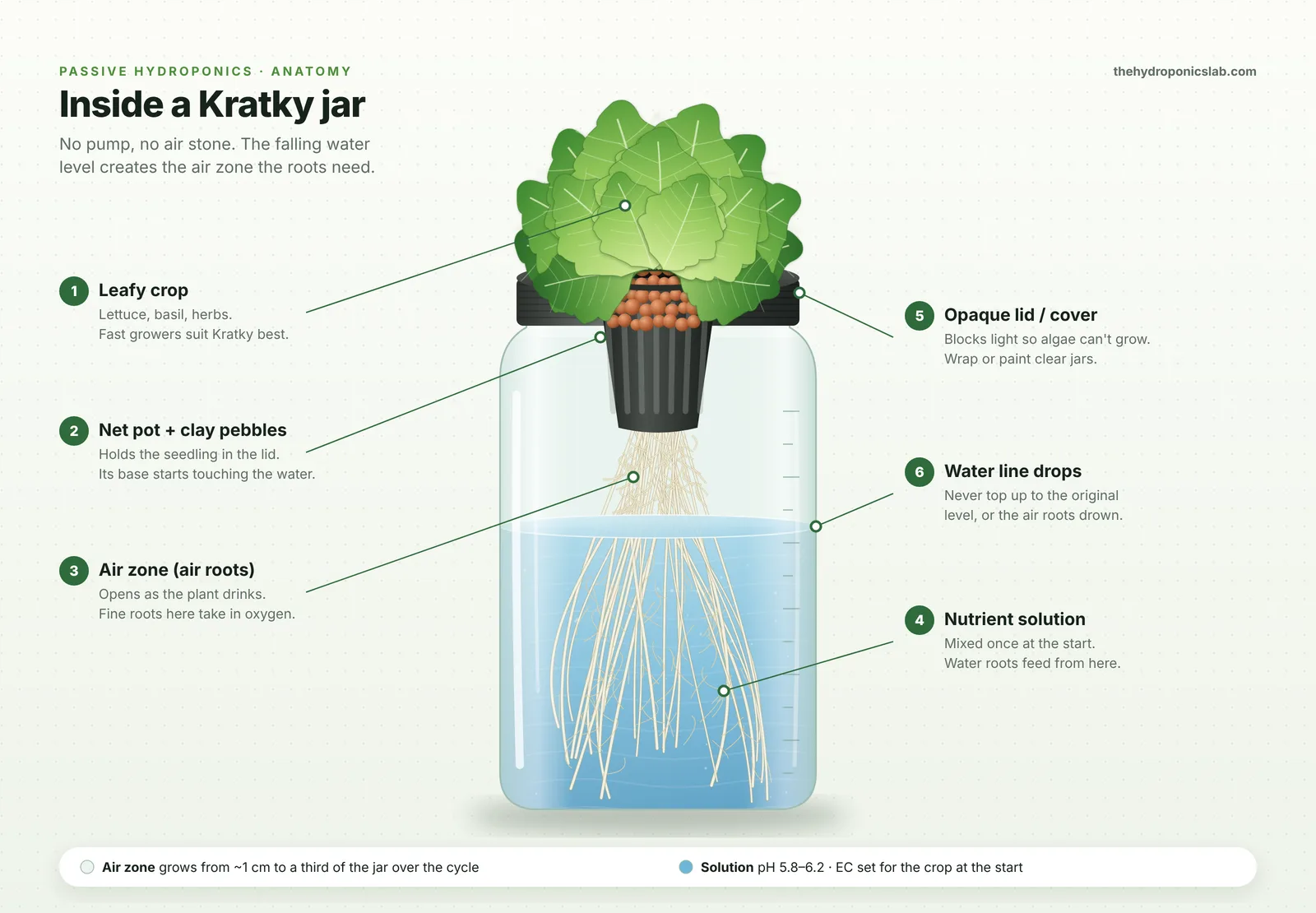
At the start, the reservoir is full and the bottom of the net pot touches the solution. The seedling's roots grow down into the liquid and begin to drink. As the plant takes up water, the level drops a little every day. The space that opens between the lid and the water surface is the air gap.
The roots adapt to this. The upper part of the root mass, now hanging in humid air, develops fine, fuzzy roots that take in oxygen. The lower part stays in the solution and takes in water and nutrients. Growers often call these air roots and water roots. A healthy Kratky plant has both, and you can see the difference clearly in a clear jar: white, branching roots above, longer and smoother roots below.
This is why the most important rule of Kratky is also the most counter-intuitive one: do not refill the container to the top. If you flood the air gap, you drown the air roots, which have adapted to air and cannot cope with being submerged. The plant can wilt within a day and root rot often follows. We explain how to top up safely in the section on water.
Why it needs no pump
In a deep water culture (DWC) system the roots live permanently underwater, so an air pump has to keep adding oxygen. In Kratky, the plant itself opens the air gap at roughly the rate it needs one. Fast-growing leafy crops use water quickly and open the gap quickly; small seedlings use little water and need little air. As long as the container is sized correctly for the crop, the system balances itself.
Pros and cons of the Kratky method
| Pros | Cons |
|---|---|
| No pump, no air stone, no electricity | Best for leafy greens and herbs; fruiting crops need large containers |
| Cheapest hydroponic setup to build (from about $10 for a jar) | You cannot fully refill the reservoir without care |
| Nothing mechanical to break | pH and nutrient strength must be right from day one |
| Silent, clean and odor-free when sealed | Warm rooms reduce oxygen in the water |
| Almost no daily work | Light leaks cause algae if the container is not opaque |
| Great for children, gifts and small spaces | Large plants drink the reservoir dry quickly |
The last point matters most. The bigger the plant, the more water it uses and the bigger the container has to be. A head of lettuce is perfect. A tomato plant can be grown this way, but it needs a large tank and more attention.
What you need
The shopping list is short, and much of it is already in your kitchen.
- A container. A wide-mouth mason jar (1 quart or 2 quarts), a 5-gallon bucket with a lid, or a plastic storage tote. It must be food-safe and clean.
- Something to block the light. If the container is clear, wrap it in foil, a paper sleeve, black tape or a sock. Light on the solution grows algae.
- Net pots. 2 inch net pots fit jar lids; 3 inch pots suit buckets and totes.
- A growing medium. Rockwool cubes, coco coir plugs or clay pebbles (LECA) to hold the seedling in the pot.
- Hydroponic nutrients. A complete nutrient made for hydroponics, not a garden fertilizer for soil. A two-part or three-part liquid for leafy greens is the easiest to dose.
- A pH test kit or meter, plus pH Down (and pH Up, though you rarely need it).
- Seeds or seedlings. Loose-leaf lettuce, butterhead lettuce, basil, spinach or kale.
- A light source. A bright south-facing window (north-facing in Australia) works in summer; an LED grow light is needed in winter or indoors.
Optional but useful: an EC/TDS meter, a hole saw for cutting lids, and a measuring syringe for nutrients.
Step-by-step Kratky setup
This is the setup for one 1-quart mason jar with a loose-leaf lettuce plant. For a bucket or tote, the steps are the same; you just cut more holes.
Step 1: Start your seed
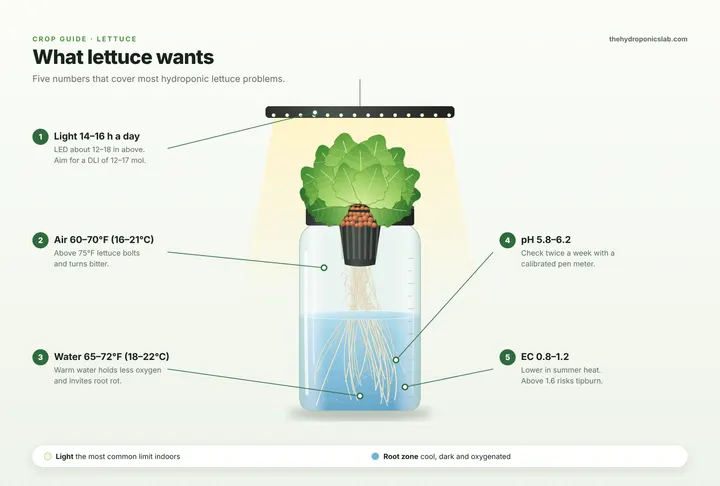
Soak a rockwool cube in pH-adjusted water (pH about 5.5) for an hour, squeeze it gently, and press one or two lettuce seeds into the hole. Lettuce seeds need light to germinate, so do not bury them deeply. Keep the cube moist and at room temperature (60 to 70°F, 15 to 21°C). Seeds sprout in 2 to 7 days.
You can also start the seed directly in the net pot. Starting in a tray is better when you have several plants, because you only transplant the strongest seedlings.
Step 2: Prepare the container
Clean the jar or bucket with hot soapy water and rinse it well. If it is clear, wrap it in a light-proof sleeve, leaving a narrow vertical slot you can uncover to check the water level. For a bucket or tote, cut holes in the lid slightly smaller than the rim of your net pots so they sit snugly.
Spacing guide for totes and buckets: one lettuce or basil plant every 6 to 8 inches (15 to 20 cm).
Step 3: Mix the nutrient solution
Fill a separate jug with water. Add nutrients following the label, usually at the "seedling" or "leafy greens" rate, and stir well. If your nutrient has more than one part, add each part separately to the water and stir between them. Never mix the concentrates together.
Then check the pH and adjust it to 5.8 to 6.2 with a few drops of pH Down. Retest after one minute of stirring. Details are in the next section.
Step 4: Fill the container to the right level
Pour the solution into the container until it will touch the bottom quarter to half inch of the net pot once the pot is in place. The rockwool cube should sit with its base in the liquid, not fully submerged. This level lets the seedling drink while its top stays dry and breathable.
Step 5: Transplant the seedling
When the seedling has two or three true leaves and roots poking out of the cube (usually 10 to 14 days), place the cube in the net pot. Fill around it with clay pebbles or coco if it is loose. Set the pot in the lid.
Step 6: Place it in the light
Lettuce and herbs want 12 to 16 hours of light a day. Under an LED grow light, keep the light 12 to 18 inches above the leaves (check the manufacturer's guidance). On a windowsill, turn the jar every few days so the plant grows evenly.
Step 7: Leave it alone
This is the hard part. Check the plant every day or two, look at the water level through the slot, but do not refill. Within a week you will see roots grow down into the water and the level begin to fall.
Step 8: Harvest
Loose-leaf lettuce is usually ready 30 to 45 days after transplanting. You can cut the whole plant, or pick the outer leaves and let it keep growing until the solution runs low.
Nutrients and pH for Kratky
Because you will not change the solution during the crop, getting the mix right at the start matters more in Kratky than in any other system. The good news is that leafy greens are forgiving.
Which nutrient to use
Use a complete hydroponic nutrient that contains all the macronutrients (nitrogen, phosphorus, potassium, calcium, magnesium, sulfur) and micronutrients (iron, manganese, zinc, copper, boron, molybdenum). Soil fertilizers often lack calcium, magnesium or trace elements because they assume the soil will supply them. In hydroponics, the solution is the plant's only source.
You can choose between:
- Two-part or three-part liquids: easiest to measure, widely available in the US, UK, Canada and Australia.
- Powder nutrients: cheaper per gallon and long-lasting. Some lettuce-specific powders are designed to be mixed with calcium nitrate and Epsom salt.
- One-part liquids or powders: the simplest, ideal for jars.
Our full guide to hydroponic nutrients explains the differences in depth.
How strong to make it
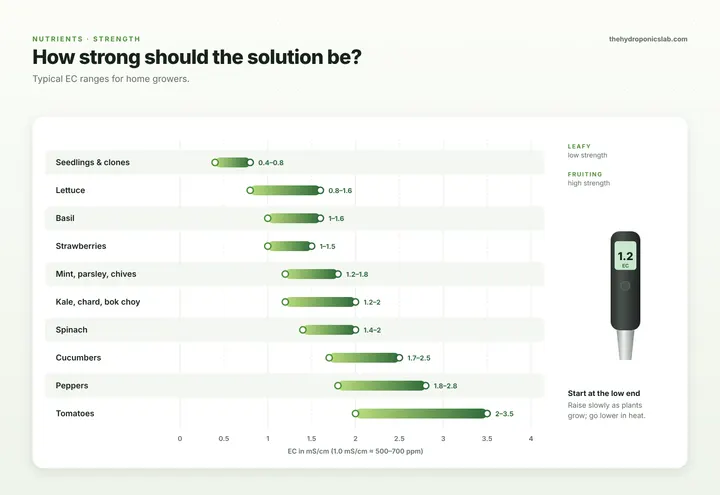
For lettuce and most leafy herbs, aim for an EC of 1.0 to 1.6 mS/cm, which is about 500 to 800 ppm on the 500 scale (the scale most US meters use) or 700 to 1,100 ppm on the 700 scale (common in the UK and Australia). If you do not have a meter, follow the label's dose for leafy greens and start at half to three quarters of the full-strength rate for very young seedlings.
A useful rule from Kratky's own work: a slightly weaker solution is safer than a stronger one. As the plant drinks water faster than it uses salts, the solution can become more concentrated over the crop, especially in warm weather.
Getting the pH right
The pH controls whether plants can actually absorb the nutrients in the water. Most nutrients are available to plants between pH 5.5 and 6.5. For Kratky, mix to 5.8 to 6.2 at the start. The pH will drift upward slowly as the plant grows; that is normal and usually harmless in a short lettuce crop.
How to adjust: add pH Down a drop at a time, stir, wait a minute, and test again. Always adjust the pH after you add nutrients, never before. Read more in our guide to the ideal pH for hydroponics.
Best plants for Kratky (and which to avoid)
Kratky works best with plants that grow fast, stay compact and are harvested for their leaves. Plants that flower and fruit need more water and nutrients over a longer time.
| Plant | How well it does | Container per plant | Days to harvest (from transplant) |
|---|---|---|---|
| Loose-leaf lettuce | Excellent | 1 quart to 1 gallon | 30 to 45 |
| Butterhead lettuce | Excellent | 1 to 1.5 gallons | 35 to 50 |
| Romaine | Very good | 1.5 to 2 gallons | 45 to 60 |
| Spinach | Good (prefers cool rooms) | 1 gallon | 30 to 45 |
| Kale and Swiss chard | Very good | 2 to 3 gallons | 30 to 50, then pick for weeks |
| Bok choy | Very good | 1 to 2 gallons | 30 to 45 |
| Basil | Very good | 1 to 2 gallons | 25 to 35 for first cut |
| Mint, parsley, cilantro, chives | Good | 1 gallon | 30 to 50 |
| Green onions | Excellent | 1 quart | 20 to 30 |
| Cherry tomatoes, peppers, cucumbers | Possible, not for beginners | 5 to 15 gallons or more, with top-ups | 60 to 90+ |
Times are typical ranges for indoor growing and vary with variety, light and temperature.
Plants to avoid at first
- Large fruiting plants such as full-size tomatoes, cucumbers and squash. They drink gallons a week at peak growth and need staking. Kratky did grow tomatoes in large tanks, but it takes careful refilling.
- Root vegetables such as carrots, potatoes and beets. The part you eat would sit in the wet zone and rot.
- Plants that need a dry rest, such as rosemary and thyme, which prefer drier roots. They can grow, but slowly.
If you want to try tomatoes, read our dedicated guide to Kratky tomatoes first.
Container sizes and how much water each plant needs
The container has one job: hold enough solution to carry the plant all the way to harvest. If it is too small, it runs dry early; if it is far too big, the roots may never reach the air gap they need.
As a rough guide, a head of lettuce uses around 1 to 1.5 gallons (4 to 6 liters) of water over its life, depending on the variety, temperature and light. That is why a 1-quart jar suits a small loose-leaf plant or herbs, while a full head of butterhead or romaine is happier in a bigger container.
| Container | Volume | Good for |
|---|---|---|
| Mason jar, 1 quart | about 1 liter | Green onions, a small loose-leaf lettuce, herbs (with one top-up) |
| Mason jar, half gallon | about 2 liters | Loose-leaf lettuce, basil |
| 1-gallon jug or tub | about 4 liters | A full head of lettuce, spinach, bok choy |
| 5-gallon bucket | about 19 liters | 1 to 3 plants of kale or basil, 1 cherry tomato |
| 10 to 20-gallon tote | 38 to 75 liters | 4 to 8 lettuce heads or a mixed herb bed |
Can you top up a Kratky system?
Yes, with care. If the reservoir will run dry before harvest, add solution, but only to fill about half of the air gap, never back up to the original level. This keeps the upper air roots in air while giving the plant more to drink. Mix the top-up at half strength, because the remaining solution is already slightly concentrated.
In very hot weather, when plants drink fast, a mid-crop top-up is normal for larger heads of lettuce and for herbs grown for several cuts.
Common Kratky problems and how to fix them
Wilting after a top-up
Cause: the air gap was flooded and the air roots drowned. Fix: remove solution until the level is back below the main root mass. Keep the plant in shade for a day. Next time, top up only halfway into the gap.
Brown, slimy roots and a bad smell
Cause: root rot, usually from warm solution (above 75°F, 24°C) or a flooded air gap. Warm water holds less oxygen. Fix: move the container somewhere cooler, lower the level, and trim the soft brown roots. If the whole root mass is slimy, start again with a clean container. Our guide to root rot in hydroponics covers prevention.
Green water or green film on the container
Cause: algae, from light reaching the solution. Fix: cover the container fully and block light around the net pot with a small collar of foil. Algae compete for nutrients and raise the risk of rot.
Yellow leaves
Cause: usually a nutrient problem. Yellowing of the older, lower leaves often means the solution is too weak or running out of nitrogen. Yellowing between the veins of new leaves points to iron that the plant cannot absorb, often because the pH has drifted above 6.5. Fix: check the pH and EC, then adjust. See yellow leaves in hydroponics.
Brown, crispy leaf tips (tipburn)
Cause: the plant cannot move calcium fast enough to the new leaves, usually because of high temperature, low airflow or a solution that is too strong. Fix: add a small fan, keep the room below 75°F, and avoid overfeeding.
Seedling falls over or does not root
Cause: the cube sits too high above the solution or too deep in it. Fix: at the start, the base of the cube should touch the liquid. If the roots have not reached the water after a week, raise the level slightly.
Mosquitoes or fungus gnats
Cause: standing water open to the air. Fix: make sure the lid seals and the net pots fill their holes. Cover any gaps with tape.
The plant is bolting (growing tall and bitter)
Cause: heat or very long days. Lettuce runs to seed above about 75 to 80°F. Fix: grow lettuce in the cooler part of the year, choose a bolt-resistant variety, and keep lights to 14 to 16 hours.
Kratky vs DWC: which should you choose?
The Kratky method and deep water culture look alike: both suspend plants over a reservoir of solution. The difference is how the roots get oxygen.
| Kratky | Deep water culture (DWC) | |
|---|---|---|
| Oxygen supply | Air gap that forms as the water drops | Air pump and air stone, running 24/7 |
| Electricity | None | Yes, for the air pump |
| Water level | Falls through the crop | Kept constant |
| Nutrient changes | Usually none; one top-up at most | Topped up and changed every 1 to 2 weeks |
| Best crops | Leafy greens, herbs | Leafy greens, herbs, and larger fruiting plants |
| Growth speed | Good | Often faster, thanks to constant oxygen |
| Cost to start | From about $10 | From about $40 to $60 for a bucket system |
| Risk if the power fails | None | Roots can suffocate within hours |
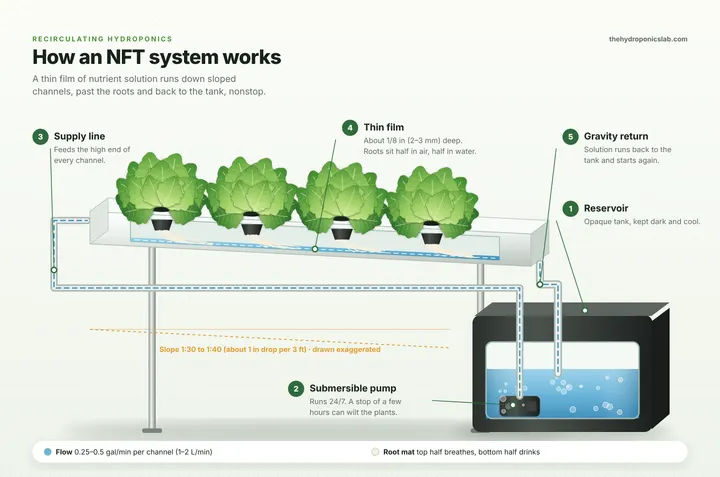
Choose Kratky if you are a beginner, want almost no maintenance, grow lettuce and herbs, or want plants in places without power. Choose DWC if you want to push growth, grow bigger plants, or run one reservoir for many plants for months. Many growers do both: Kratky jars on the windowsill, a DWC bucket for basil or tomatoes. Read the full deep water culture guide.
Frequently asked questions
Does the Kratky method really work without a pump?
Yes. The plant uses the solution, the level drops, and the upper roots take oxygen from the air gap. This was tested over many trials by Dr. Bernard Kratky at the University of Hawaii, and it is now one of the most popular home hydroponic methods.
How often do I change the water in a Kratky system?
Usually never during a single crop. You mix the solution once at the start and let the plant use it. You may top up once with half-strength solution if the container will run dry before harvest. Between crops, empty and clean the container.
Can I use tap water for Kratky?
In most of the US, UK, Canada and Australia, yes. If your water is very hard (high in calcium and magnesium), your starting EC will already be high; check it before adding nutrients and consider using part filtered or rainwater. If your water has chloramine, letting it stand does not remove it, but lettuce in a short Kratky crop usually tolerates normal municipal levels.
Can I use a mason jar for Kratky?
Yes. A wide-mouth quart or half-gallon mason jar with a 2 or 3 inch net pot is the classic beginner setup. Cover the glass to keep out light. See our guide to mason jar hydroponics.
What should the water level be at the start?
The solution should touch the bottom quarter to half inch of the net pot, so the base of the growing cube is wet but most of it is in the air.
Can I grow tomatoes with the Kratky method?
Yes, but they need a large container (at least 5 gallons for a cherry tomato, more for larger types), support for the stems and at least one or two careful top-ups. They are not a good first project. Start with lettuce.
What nutrients are best for Kratky lettuce?
Any complete hydroponic nutrient made for leafy greens, mixed to an EC of about 1.0 to 1.6 and a pH of 5.8 to 6.2. See Kratky nutrients for recipes and dosing tables.
Why are my Kratky roots brown?
Brown roots can simply be stained by nutrients or a coco medium. If they are also slimy and smell bad, that is root rot, usually from warm water or a flooded air gap. Healthy roots are white or cream and firm.
How long does Kratky lettuce take to grow?
Usually 30 to 45 days from transplant for loose-leaf lettuce, plus about two weeks as a seedling.
Next step
Start with one jar. Grow one lettuce from seed to harvest, write down the date you transplanted, the water level each week and the day you cut it. That single crop will give you the confidence (and the data) to scale up to a tote, a bucket or a full system.
- New to hydroponics? Begin with our Start here guide.
- Growing lettuce? Read hydroponic lettuce for varieties and a week-by-week timeline.
- Ready for more plants? Compare systems in types of hydroponic systems.
Internal links to add: all /kratky/* satellites, /nutrients/ph/, /problems/root-rot/, glossary entry "air gap".
What we tested (fill in with real data before publishing): containers used, varieties, start date, EC and pH at the start and at harvest, harvest weight.