If you grow only one thing hydroponically, make it lettuce. It is fast, forgiving, cheap to grow and far better fresh than anything in a plastic clamshell. A single plant in a jar can give you salads for weeks; a small system can keep a family in greens all winter.
This guide covers everything you need to grow hydroponic lettuce at home: the best varieties, which system to choose, the right nutrients, pH, light and temperature, a week-by-week timeline, how to harvest so it regrows, and how to fix tipburn, bolting and other common problems.
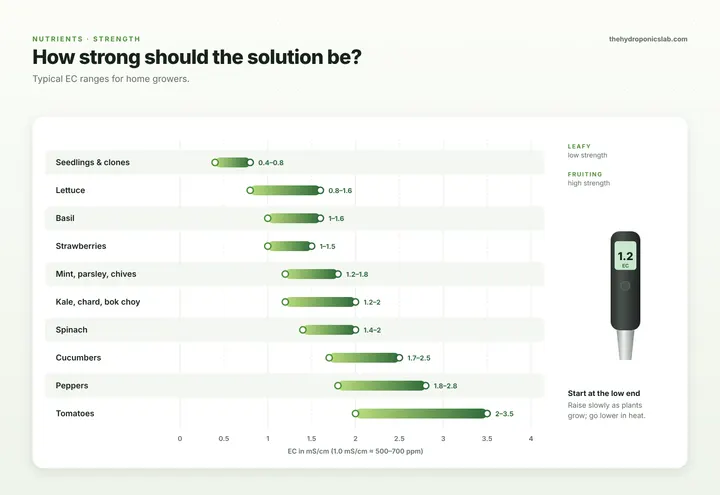
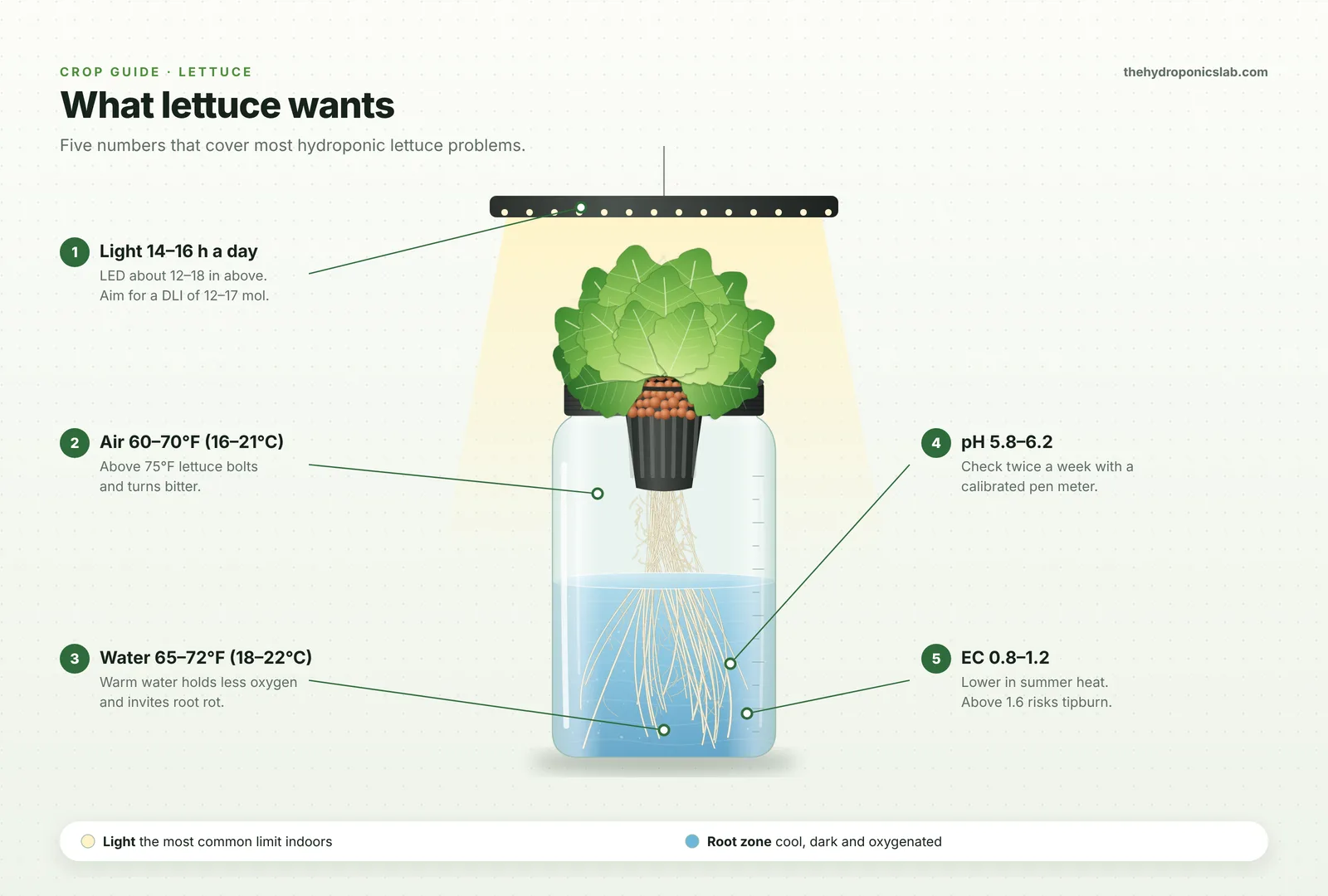
Quick answer: Hydroponic lettuce grows best at an EC of 0.8 to 1.6 mS/cm (400 to 800 ppm on the 500 scale), a pH of 5.8 to 6.2, 14 to 16 hours of light a day and air temperatures of 60 to 70°F (16 to 21°C). Loose-leaf varieties are ready 30 to 45 days after transplanting, or about 6 to 8 weeks from seed. Kratky, deep water culture and NFT all work well.
Why lettuce is the best first crop
- It grows fast. From seed to salad in six to eight weeks, so you learn quickly.
- It needs little. Low nutrient strength, moderate light, no pollination, no staking.
- It forgives mistakes. A slightly wrong pH or a missed check rarely kills it.
- It works in every system. A jar, a bucket, a tote, a pipe or a tower.
- It saves money. A head of lettuce costs a few cents in nutrients and seed.
- It tastes better. Lettuce loses crispness and flavor within days of harvest. Picked an hour before dinner, it is another vegetable.
Best lettuce varieties for hydroponics
Almost any lettuce will grow hydroponically. These types and varieties are reliable choices for indoor and home growers, and widely available in the US, UK, Canada and Australia.
| Type | Good varieties | Days to harvest (from transplant) | Why grow it |
|---|---|---|---|
| Loose-leaf | Black Seeded Simpson, Salad Bowl, Lollo Rossa, Red Sails | 30 to 40 | Fastest; pick leaves for weeks |
| Butterhead (Bibb) | Buttercrunch, Rex, Tom Thumb | 35 to 50 | Soft, sweet heads; the classic hydroponic lettuce |
| Romaine (cos) | Parris Island, Little Gem, Rouge d'Hiver | 45 to 60 | Crunchy; Little Gem is compact and quick |
| Batavia (summer crisp) | Muir, Nevada, Concept | 40 to 55 | Tolerates heat and resists bolting |
| Oakleaf | Green Oakleaf, Red Oakleaf | 30 to 45 | Pretty, mild, slow to turn bitter |
| Iceberg (crisphead) | Great Lakes | 60 to 80 | Possible, but slow and needs cool conditions |
Beginner pick: a loose-leaf or a butterhead. Warm room or summer pick: a Batavia such as Muir, bred to resist bolting.
Which system to choose
| System | Effort | Cost to start | Best for | Notes |
|---|---|---|---|---|
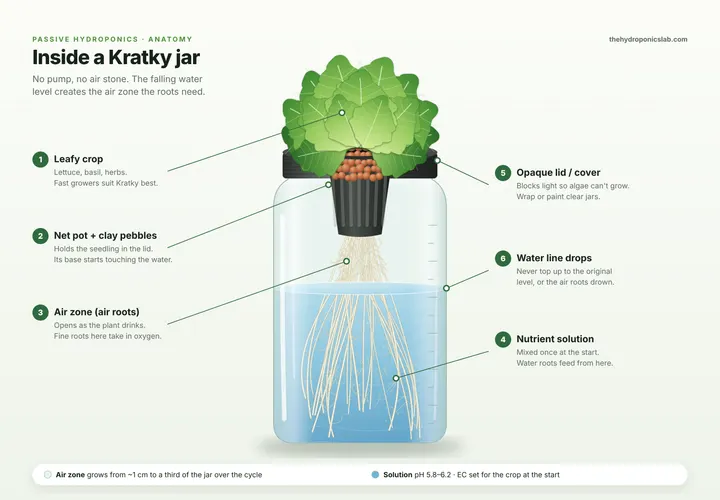
| Kratky | Lowest | From about $10 | 1 to 8 plants, beginners, kitchens | No pump; one jar or tote per crop |
| Deep water culture | Low | From about $40 to $60 | 4 to 20 plants, continuous harvest | Air pump runs 24/7; very forgiving |
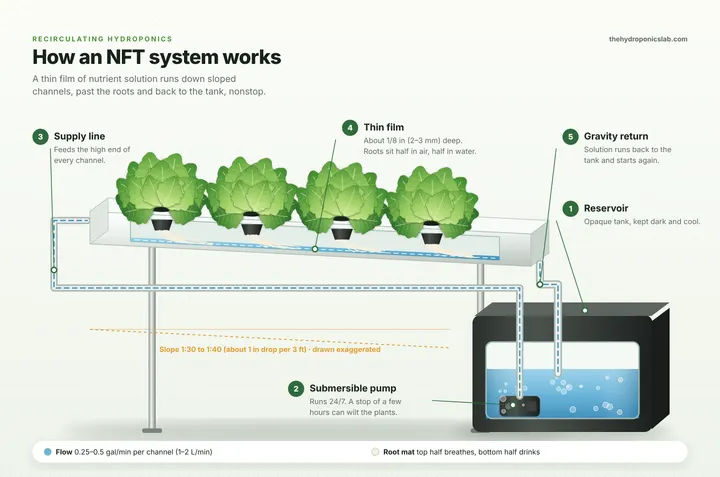
| NFT | Moderate | From about $100 to $200 | 15 or more plants, greenhouses, vertical setups | Fast growth, efficient, needs a pump and slope |
| Vertical tower | Moderate | $150 and up | Small floor space | Usually a drip or NFT variant |
| Countertop smart garden | Lowest | $80 to $300 | A few plants, no setup | Convenient, limited size |
If this is your first lettuce, start with Kratky: one 1-gallon container per head, no electricity, no maintenance. If you want lettuce every week, move to DWC or NFT and plant a few seedlings every week.
Nutrients, EC and pH for lettuce
Lettuce is a light feeder. Many problems come from overfeeding, not underfeeding.
| Stage | EC (mS/cm) | ppm (500 scale) | ppm (700 scale) | pH |
|---|---|---|---|---|
| Seedling (until 2 to 3 true leaves) | 0.4 to 0.8 | 200 to 400 | 280 to 560 | 5.8 to 6.2 |
| Growing | 0.8 to 1.2 | 400 to 600 | 560 to 840 | 5.8 to 6.2 |
| Mature, cool conditions | 1.2 to 1.6 | 600 to 800 | 840 to 1,120 | 5.8 to 6.2 |
Tips:
- Use a complete hydroponic nutrient made for leafy greens, with a good level of nitrogen and calcium.
- In warm, bright weather, stay at the lower end: the plants drink more and the solution gets stronger.
- In recirculating systems, change the solution every 1 to 2 weeks and top up with water in between.
- In Kratky, mix once at about EC 1.0 to 1.2 and let the plant use it.
For product types and mixing, see hydroponic nutrients, and for a full lettuce feeding plan see hydroponic nutrients for lettuce.
Light and temperature
Light
Lettuce wants plenty of light, but not as much as tomatoes. Indoors, plan for 14 to 16 hours a day under an LED grow light. In growing terms, lettuce does well with a daily light integral (DLI) of about 12 to 17 mol/m²/day; above that, tipburn becomes more likely unless airflow and calcium are good.
- LED grow lights: a full-spectrum LED designed for plants, hung at the height the manufacturer recommends (often 12 to 24 inches above the leaves).
- Windowsill: a bright south-facing window (north-facing in Australia) works from spring to autumn. In winter, at northern latitudes such as the UK and Canada, daylight is too short and weak for good heads; add a light.
- Signs of too little light: long, pale, stretched stems and loose, floppy leaves.
Temperature
| Factor | Ideal | Problem zone |
|---|---|---|
| Air, day | 60 to 70°F (16 to 21°C) | Above 75 to 80°F: bolting, bitterness, tipburn |
| Air, night | 50 to 60°F (10 to 16°C) | Below 40°F: very slow growth |
| Nutrient solution | 65 to 72°F (18 to 22°C) | Above 75°F: low oxygen and root rot |
| Germination | 60 to 68°F (15 to 20°C) | Above about 80°F many seeds will not sprout |
| Humidity | 50 to 70% | Very high humidity with poor airflow: tipburn, mold |
A small fan moving air gently over the leaves is one of the best upgrades for indoor lettuce: it reduces tipburn and mold and strengthens the plants.
Week-by-week timeline
This timeline is for a loose-leaf or butterhead lettuce under good indoor conditions. Romaine and crisphead take one to three weeks longer.
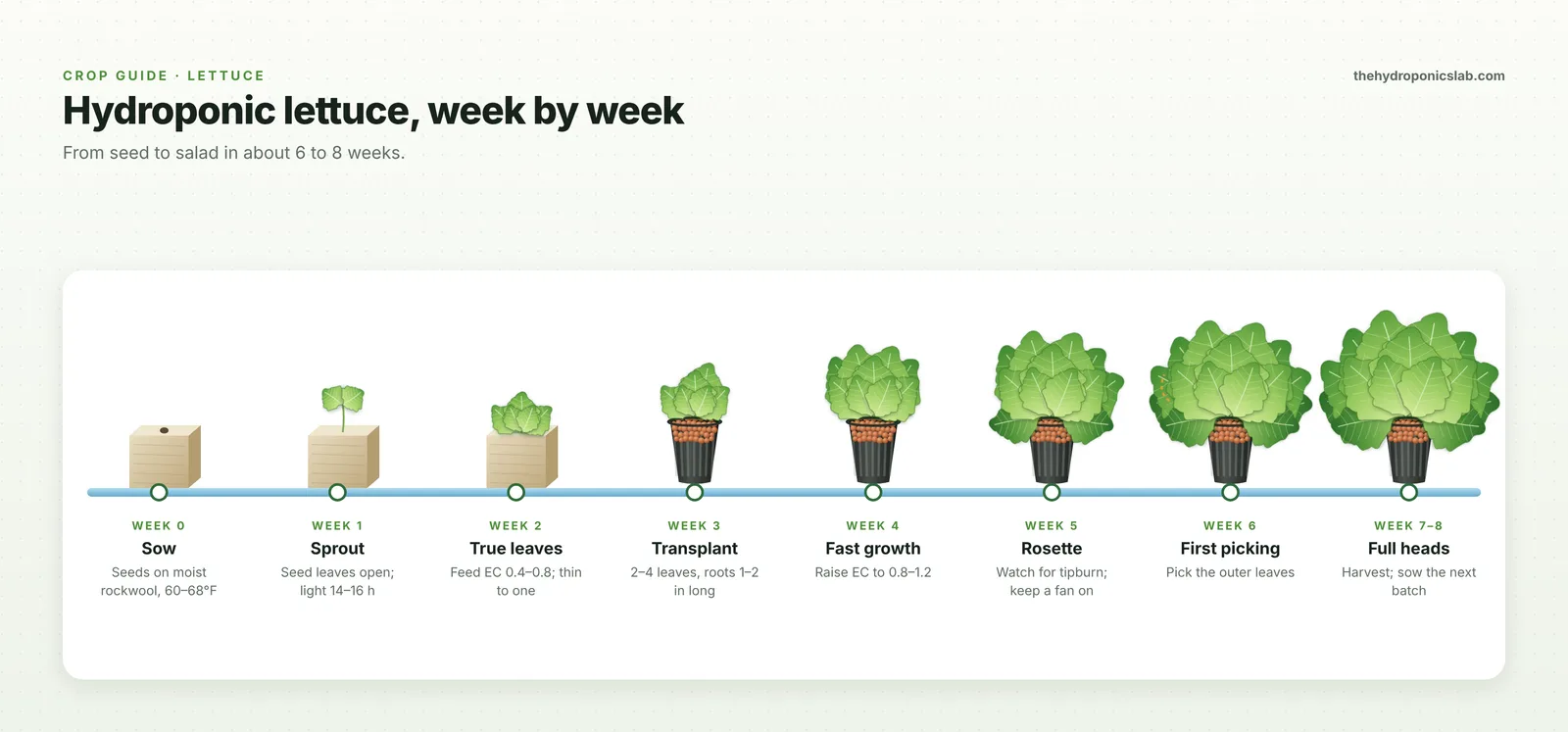
| Week | What happens | What to do |
|---|---|---|
| 0 | Sow seeds in moist rockwool or coco plugs | Keep at 60 to 68°F; press seeds onto the surface, they need light to sprout |
| 1 | Seeds sprout (2 to 7 days); seed leaves open | Start the light at 14 to 16 hours; water with plain pH-adjusted water or EC 0.4 |
| 2 | First true leaves; roots appear at the bottom of the cube | Feed at EC 0.4 to 0.8; thin to one seedling per cube |
| 3 | 2 to 4 true leaves, roots 1 to 2 inches long | Transplant into your system |
| 4 | Fast leaf growth; roots reach deep into the solution | Raise EC to 0.8 to 1.2; check pH twice a week |
| 5 | Plant the size of a hand, rosette forming | Check for tipburn; keep a fan on |
| 6 | Loose-leaf ready for first picking | Pick outer leaves or harvest whole |
| 7 to 8 | Butterhead forms a full head | Harvest whole heads; sow the next batch now |
| 9+ | Leaves get bitter if heat or long days trigger bolting | Harvest before the center starts to stretch upward |
For a continuous supply, sow a few seeds every 1 to 2 weeks. Each batch replaces the one you harvest.
Harvesting and regrowing
There are two ways to harvest hydroponic lettuce:
- Cut-and-come-again (loose-leaf and romaine): pick the outer, larger leaves and leave the center to keep growing. You can harvest every 5 to 7 days for three or four weeks.
- Whole-head harvest (butterhead, romaine, Batavia): cut the whole plant at the base, or pull it out with the roots on. Lettuce with roots attached, kept in a container with a little water in the fridge, stays fresh for a week or more. This is how "living lettuce" is sold in supermarkets.
Can it regrow from the stump? If you cut a head about an inch above the base and leave the plant in the system, it often regrows a smaller second crop of leaves. The second harvest is usually smaller and can be more bitter, so many growers prefer to start a fresh seedling instead.
Harvest in the morning, when leaves are cool and crisp.
Troubleshooting
Tipburn (brown, crispy edges on new leaves)
The most common lettuce problem indoors. It is a calcium problem, but rarely a shortage in the water: the plant cannot move calcium to fast-growing inner leaves because they transpire too little. Fixes: improve airflow with a fan, lower the temperature, avoid very high light, keep the EC moderate, and keep humidity below about 70%.
Bolting (the plant stretches upward and tastes bitter)
Lettuce flowers in response to heat and long days. Fixes: keep air below 75°F, use 14 to 16 hours of light rather than 18 or more, choose bolt-resistant varieties (Batavia, Little Gem), and harvest on time.
Yellow lower leaves
Usually nitrogen running low, or old leaves naturally aging. Fixes: check EC and raise it a little; remove old leaves that touch the lid.
Yellowing between the veins on new leaves
Often iron that cannot be absorbed because the pH is above 6.5. Fix: bring the pH back to 5.8 to 6.2. See yellow leaves in hydroponics.
Slimy brown roots
Root rot, usually from warm solution, poor oxygen or a flooded Kratky air gap. Fixes: cool the solution below 72°F, increase aeration in DWC, keep the Kratky gap open. See root rot.
Leggy, pale seedlings
Too little light, or the light too far away. Fix: lower the light or add hours. Bury the stretched stem a little deeper in the net pot when you transplant.
Seeds not germinating
Too warm, buried too deep, or old seed. Fixes: keep germination at 60 to 68°F, sow on the surface, and use fresh seed.
Frequently asked questions
How long does hydroponic lettuce take to grow?
Loose-leaf lettuce is usually ready 30 to 45 days after transplanting, or about 6 to 8 weeks from seed. Butterhead and romaine take a little longer.
What is the best EC for hydroponic lettuce?
About 0.8 to 1.2 mS/cm while growing and up to 1.6 for mature plants in cool conditions. That is 400 to 800 ppm on the 500 scale.
What pH does lettuce need in hydroponics?
5.8 to 6.2. Lettuce tolerates 5.5 to 6.5, but iron and other micronutrients become harder to absorb above 6.5.
How many hours of light does hydroponic lettuce need?
14 to 16 hours a day under grow lights. More than 18 hours can encourage bolting and tipburn.
How much space does one lettuce plant need?
About 6 to 8 inches (15 to 20 cm) between plants for loose-leaf and butterhead, 8 to 10 inches for romaine.
Can I grow lettuce with the Kratky method?
Yes, it is the ideal Kratky crop. Use about 1 gallon of solution per full head. See Kratky lettuce.
Is hydroponic lettuce as healthy as soil-grown lettuce?
Yes. Studies of hydroponic and soil-grown lettuce generally find similar nutritional value, and hydroponic lettuce is often cleaner, with no soil or grit. Freshness has the biggest effect on vitamins, and home-grown lettuce is as fresh as it gets.
Why is my hydroponic lettuce bitter?
Heat, long days or age. Bitterness usually comes just before bolting. Keep it cool and harvest earlier.
Next step
Pick one variety, one system and one date. Sow four seeds this week, transplant the best two, and keep a short log of EC, pH and harvest date. By your third batch, you will have your own perfect recipe.
- No system yet? Start with the Kratky method.
- Want more plants? Compare NFT and DWC.
- Feed it right: hydroponic nutrients.
Internal links to add: /kratky/, /systems/nft/, /systems/dwc/, /nutrients/.
What we tested (fill in before publishing): varieties grown, system, start and harvest dates, EC and pH, harvest weight per head.